
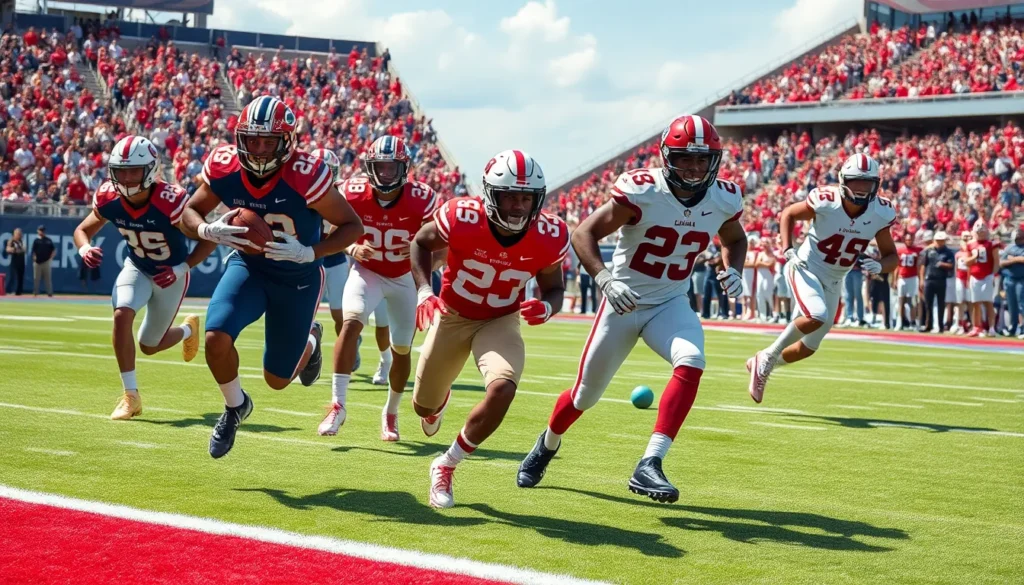
In the world of college football, speed is a game-changer. As teams gear up for the NCAA 25 season, fans are eager to discover who holds the title of the fastest players on the field. These athletes can turn the tide of a game with their explosive speed and agility, making them invaluable assets to their teams.
Overview of NCAA 25
NCAA 25 showcases a competitive landscape where speed plays a crucial role in determining team success. Players known for their quickness impact gameplay by outmaneuvering opponents and creating scoring opportunities. Teams recognize that incorporating faster players into their rosters enhances their overall performance.
Speed metrics often use 40-yard dash times to evaluate players. In NCAA 25, players achieving times under 4.4 seconds consistently rank among the fastest. Notable examples include athletes from various positions, such as wide receivers and defensive backs, who excel in speed.
Teams leverage this speed by implementing strategies that maximize quick players’ impact. Offensive schemes often revolve around utilizing speed to stretch defenses, while defensive strategies focus on maintaining pace to counter fast opponents. The excitement around identifying and developing fast players adds to the anticipation of the NCAA 25 season.
Criteria for Speed Rankings

Speed rankings in NCAA 25 rely on precise measurements and various influential factors. Understanding these criteria is essential to recognizing the true fastest players on the field.
Measuring Speed
Measuring speed primarily involves the 40-yard dash, a standard test for evaluating a player’s acceleration and top-end speed. Timing starts from a stationary position, with players sprinting 40 yards. Laser systems provide accurate results, with times under 4.4 seconds indicating elite speed. Some programs also utilize GPS technology during practices and games to track players’ speeds in real-time, capturing metrics such as maximum velocity and average speed during plays. Combining these methods results in a comprehensive assessment of a player’s speed capabilities.
Factors Influencing Performance
Factors influencing speed include physical conditioning, biomechanics, and game situations.
- Physical conditioning: Strength and endurance training contribute significantly to a player’s speed. Fitness regimens focusing on agility, sprinting, and explosive movements enhance overall quickness.
- Biomechanics: Proper running form and technique impact acceleration and top speed. Coaches emphasize optimizing stride length and frequency to maximize speed efficiency.
- Game situations: Speed often varies with context. High-pressure scenarios, such as close game situations or defensive pressure, can elevate a player’s performance, highlighting their ability to adapt and react quickly.
- Equipment: Footwear plays a role in a player’s speed. Lightweight, specialized cleats designed for optimal traction can affect acceleration and speed on the field.
- Nutrition and recovery: Proper nutrition fuels performance, while adequate recovery prevents injury, ensuring athletes maintain peak speed throughout the season.
These factors collectively shape a player’s speed and performance, making the evaluation process intricate yet essential for ranking the fastest players in NCAA 25.
Top Fastest Players in NCAA 25
Identifying the top fast players in NCAA 25 highlights the remarkable talent shaping the upcoming season. These athletes excel not only in raw speed but also in their ability to leverage agility and intelligence on the field.
Player Profiles
- Tyreek Johnson, WR
Tyreek Johnson stands out with a 40-yard dash time of 4.29 seconds. His exceptional acceleration and route-running ability make him a formidable receiver. Johnson’s capacity to create separation from defenders enhances his team’s offensive strategies, making him a vital asset.
- Adrian Turner, DB
Adrian Turner clocked a 4.32-second 40-yard dash. His speed allows him to cover ground quickly, making him a critical component in defensive schemes. Turner’s adeptness at reading the quarterback contributes to his success in intercepting passes and breaking up plays.
- Marcus Lee, RB
Marcus Lee boasts a 4.35-second 40-yard dash. His blend of speed and power helps him navigate through defenses effectively. Lee’s quick burst allows him to exploit gaps, creating significant yardage on critical downs.
- Ethan Smith, LB
Ethan Smith’s speed registered at 4.40 seconds in the 40-yard dash. As a linebacker, his ability to cover sideline to sideline enhances his team’s defensive capabilities. Smith’s speed assists in tracking down ball carriers and executing plays in coverage.
- Jordan Sanchez, WR
Jordan Sanchez recorded a 4.34-second 40-yard dash time. His breakaway speed and precise catching ability make him a versatile threat on the field. Sanchez’s knowledge of offensive schemes allows him to position himself strategically for optimal yardage.
These players exemplify the critical role speed plays in NCAA 25, not only influencing individual performance but also shaping overall team dynamics.
Comparison of Speed Across Positions
Speed plays a vital role across various positions in NCAA 25, influencing tactics and player effectiveness. Understanding how speed varies between positions allows teams to maximize individual strengths.
Wide Receivers
Wide receivers prioritize speed to create separation from defenders. A player like Tyreek Johnson, with a 40-yard dash time of 4.29 seconds, exemplifies this speed. Quick acceleration and reliable route-running enhance the passing game, making wide receivers crucial for offensive success.
Defensive Backs
Defensive backs rely on speed to match the pace of fast receivers. Adrian Turner, clocking in at 4.32 seconds, showcases the ability to close gaps quickly and maintain coverage under pressure. This speed is essential for effectively neutralizing threats from opposing offenses.
Running Backs
Running backs combine speed with agility to navigate through defenses. Players like Marcus Lee, who runs the 40-yard dash in 4.35 seconds, demonstrate effective acceleration and power. Their speed enables them to exploit openings and break away for significant gains.
Linebackers
Linebackers require speed for both tackling and coverage duties. Ethan Smith’s 4.40-second time illustrates the need for quick lateral movement and the ability to react swiftly to offensive plays. Speed in this position enhances overall defensive performance.
Speed Across the Board
Speed across these positions underscores a team’s strategy in NCAA 25. Fast players not only impact their own game but also dictate how teams implement offensive and defensive schemes, leading to enhanced overall performance.
Impact of Speed on College Football
Speed significantly impacts college football, influencing game outcomes and team strategies. Players with remarkable speed can change the dynamics of a match, creating scoring chances and making essential defensive stops. Quick players excel in outmaneuvering opponents, allowing teams to implement offensive systems that stretch defenses and exploit weaknesses.
Evaluating players’ speed typically involves measuring 40-yard dash times, with players achieving under 4.4 seconds considered elite. Speedy positions, such as wide receivers and defensive backs, directly benefit from these metrics, allowing teams to recruit and develop talent tailored to their strategies. The excitement surrounding these athletes generates anticipation among fans and enhances the competitiveness of NCAA 25.
The measurement of speed utilizes advanced techniques, including laser timing and GPS technology. Players’ performances can vary based on numerous factors such as physical conditioning, biomechanics, and in-game situations. Strength training and proper nutrition contribute to improving speed, while gear choices like lightweight cleats impact performance.
Position-specific speed requirements dictate training regimens and game plans. Wide receivers prioritize speed to gain separation, ensuring their reception chances increase. Conversely, defensive backs rely on speed to keep pace with quick receivers, while running backs benefit from a blend of speed and agility to navigate through defenses. Linebackers also require speed for tackling and coverage duties, showcasing its importance across all positions.
Understanding the significance of speed in college football allows teams to maximize athletes’ potential, improve game strategies, and ultimately achieve success in NCAA 25.
The excitement surrounding the fastest players in NCAA 25 highlights the critical role speed plays in college football. These athletes not only elevate their teams’ performance but also create thrilling moments that captivate fans. As teams refine their strategies to leverage speed, the impact of quick players becomes increasingly evident on the field.
With advanced measurement techniques and a focus on training, the identification of top talent continues to evolve. The anticipation for the season builds as players like Tyreek Johnson and Adrian Turner showcase their skills. Speed will undoubtedly remain a game-changer in NCAA 25, shaping the future of college football and influencing the dynamics of every matchup.